MacroSnaps10 October 2026
No. 91South Korean women now have about 0.7 children each on average, the lowest rate any country has ever recorded.
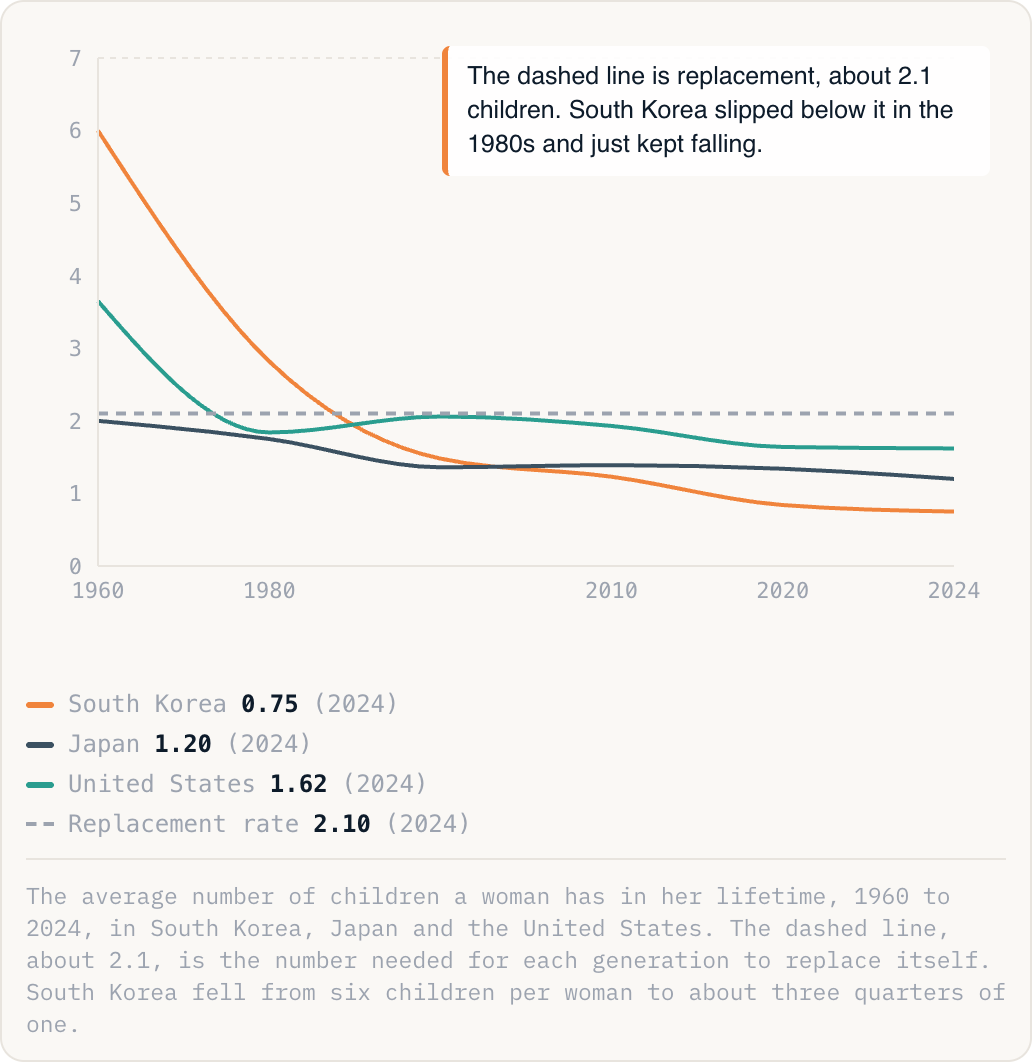
The dashed line is replacement, about 2.1 children. South Korea slipped below it in the 1980s and just kept falling.
South Korea0.75(2024)Japan1.20(2024)United States1.62(2024)Replacement rate2.10(2024)
The average number of children a woman has in her lifetime, 1960 to 2024, in South Korea, Japan and the United States. The dashed line, about 2.1, is the number needed for each generation to replace itself. South Korea fell from six children per woman to about three quarters of one.
Why this is happening
- Housing in Seoul and the cost of private education are so high that many couples decide a single child, or none, is all they can afford.
- A brutal work culture of long hours leaves little room for family life, and the burden still falls mostly on women, who pay the steepest career price for having children.
- Marriage, still the social precondition for children in Korea, has been falling for years, so fewer births follow.
The take
Two parents having 0.7 children means each generation is about a third the size of the one before. That is not a slowdown: it means a fast-shrinking, ageing population, with fewer workers to pay for more pensioners. Birth rates are falling across the rich world too, which is why everyone is watching South Korea.