MacroSnaps9 October 2026
No. 90France now pays more to borrow than Italy or Greece. Lenders want the biggest extra reward for lending to France instead of Germany since the euro debt crisis of 2012.
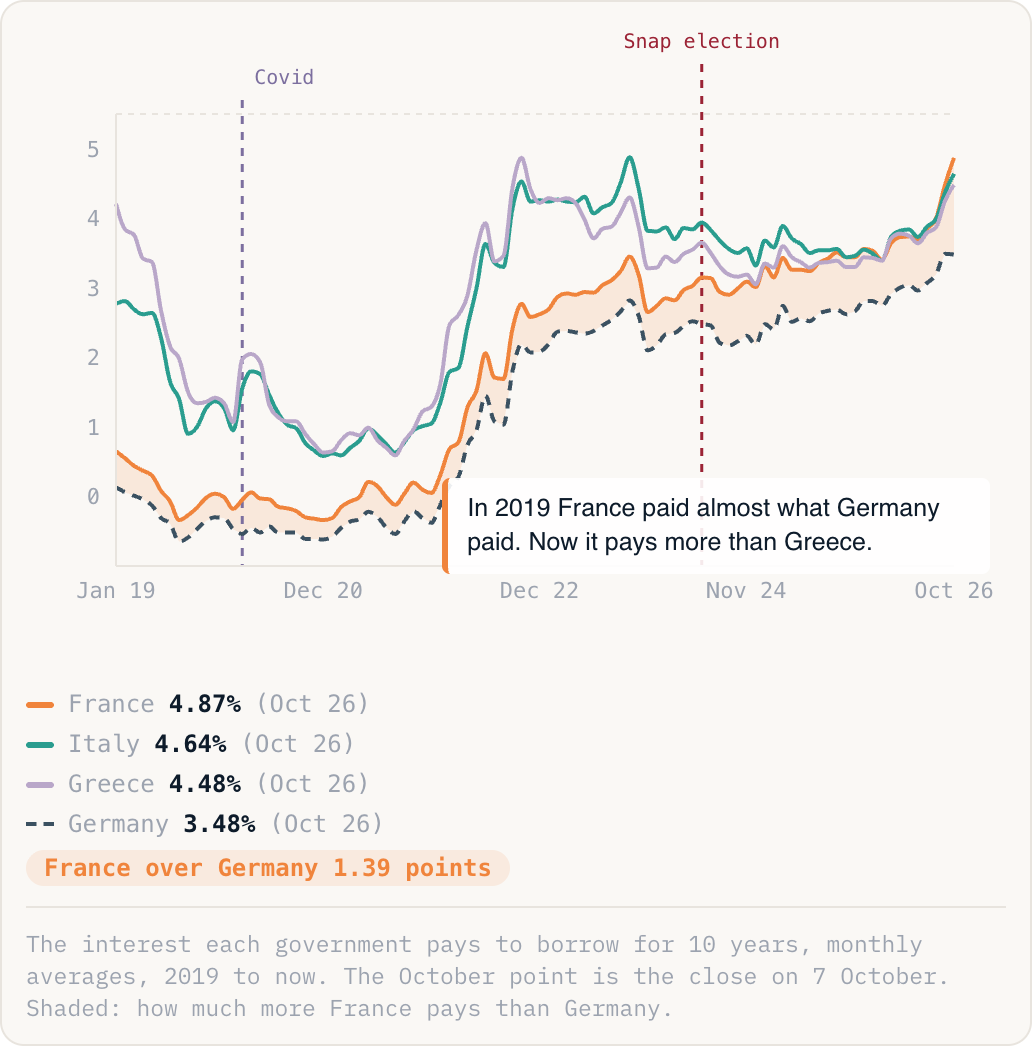
In 2019 France paid almost what Germany paid. Now it pays more than Greece.
France4.87%(Oct 26)Italy4.64%(Oct 26)Greece4.48%(Oct 26)Germany3.48%(Oct 26)France over Germany 1.39 points
The interest each government pays to borrow for 10 years, monthly averages, 2019 to now. The October point is the close on 7 October. Shaded: how much more France pays than Germany.
Why this is happening
- What the gap means. Germany is the safest borrower in Europe. The extra interest lenders want from France over Germany measures how worried they are. It went from 0.86 points on 7 September to 1.41 on 1 October, the widest since early 2012.
- Why France keeps borrowing. Its debt is nearly 120% of a year's output. The state spends 57% of the economy's output, second only to Finland in the EU. Pensions are the biggest bill, at 14%. Taxes are the second highest in the rich world, after Denmark's. Macron cut taxes for companies and the rich, but did not cut spending to match.
- Politics. Parliament has no majority. Two governments have fallen over budget cuts since December 2024. A rise in the retirement age, from 62 to 64, was suspended last year. Next spring's presidential front-runners promise more spending. Jean-Luc Mélenchon, on the far left, wants to cancel some debt.
The take
Interest is now one of France's biggest bills: over 90 billion euros next year, more than it plans to spend on defence or on schools. Every rise in rates leaves less for everything else, which is what students protesting cuts to schools are feeling now. The head of France's central bank warns the country could be "strangled by interest rates".
What could happen next
- Calm, for a while. If parliament passes a budget that shrinks the deficit, lenders may ease off. A former IMF official expects any relief to be temporary, because the debt keeps growing.
- A spiral. Ahead of next spring's election, candidates promise more spending. More borrowing makes lenders ask for more interest, which means even more borrowing. This is the scenario investors fear most.
- It spreads. Lenders could turn on Italy next, as in 2012. The European Central Bank has a tool to buy a country's bonds in a panic, but only for countries it judges to be following EU budget rules. France is already under an EU warning for overspending.