MacroSnaps25 September 2026
No. 76America, Britain, France, Germany and Japan are all paying the highest interest on their borrowing in at least 15 years. All five got there at the same time.
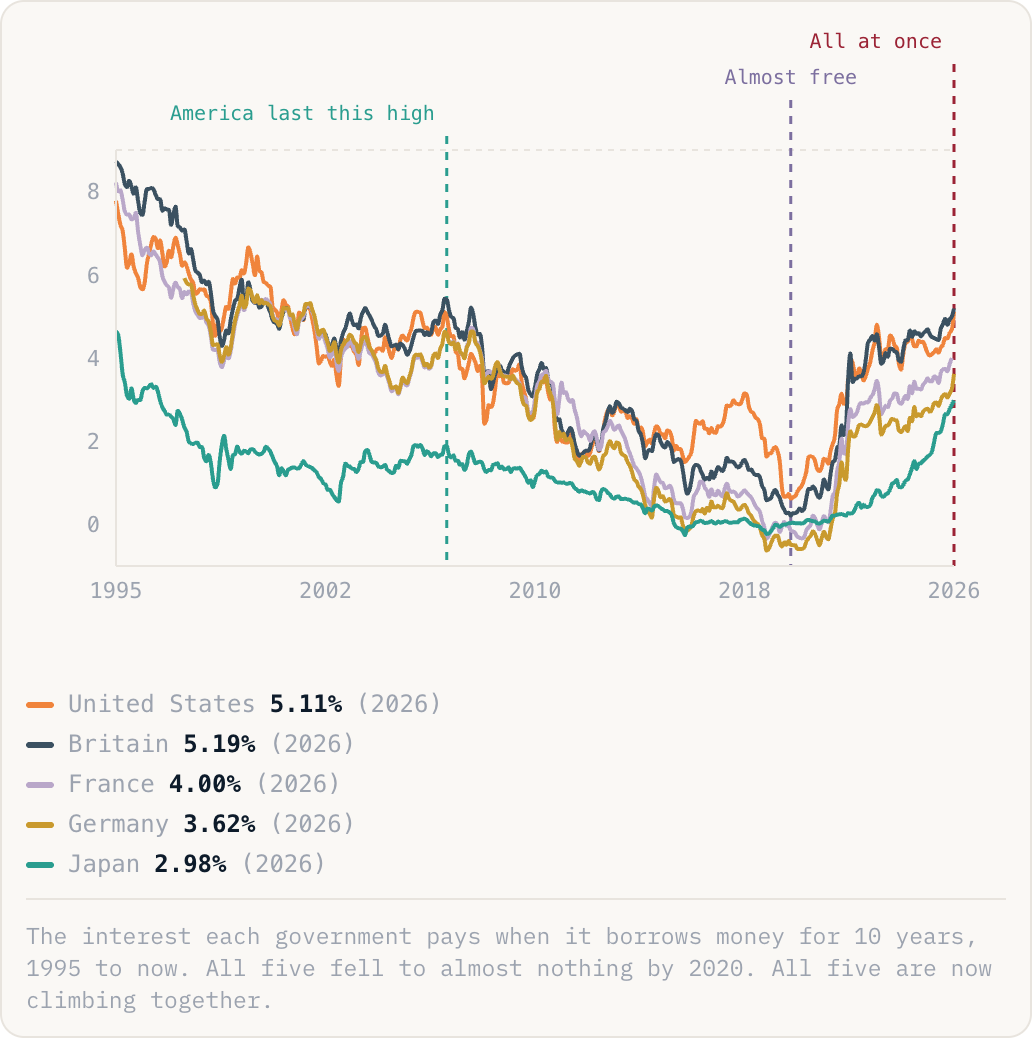
United States5.11%(2026)Britain5.19%(2026)France4.00%(2026)Germany3.62%(2026)Japan2.98%(2026)
The interest each government pays when it borrows money for 10 years, 1995 to now. All five fell to almost nothing by 2020. All five are now climbing together.
Why this is happening
- Oil is expensive. The war with Iran has shut a key route for oil tankers, and a barrel costs over $100. That pushes up the price of almost everything, and lenders want more interest to make up for it.
- Interest rates are going up, not down. In January everyone expected America's central bank to make borrowing cheaper this year. Last week it made it dearer instead, and most investors expect it to do so again next month.
- It spreads. Lenders can choose which country to lend to, so when one big government has to pay more, the others have to pay more too, or the money goes elsewhere.
The take
What governments pay to borrow sets the price of almost every other loan. The typical American mortgage rate has gone from 6.16% in January to 7.03% this week, about $230 more a month on a $400,000 home. Governments feel it too. They borrowed heavily when money was almost free, and as those loans come due they must borrow again at far higher rates, paid for by taxpayers.