MacroSnaps5 October 2026
No. 86Men outnumbered women at the world's universities until about 2003. Now women are the clear majority: 46% of young women go on to university or college, against 40% of young men.
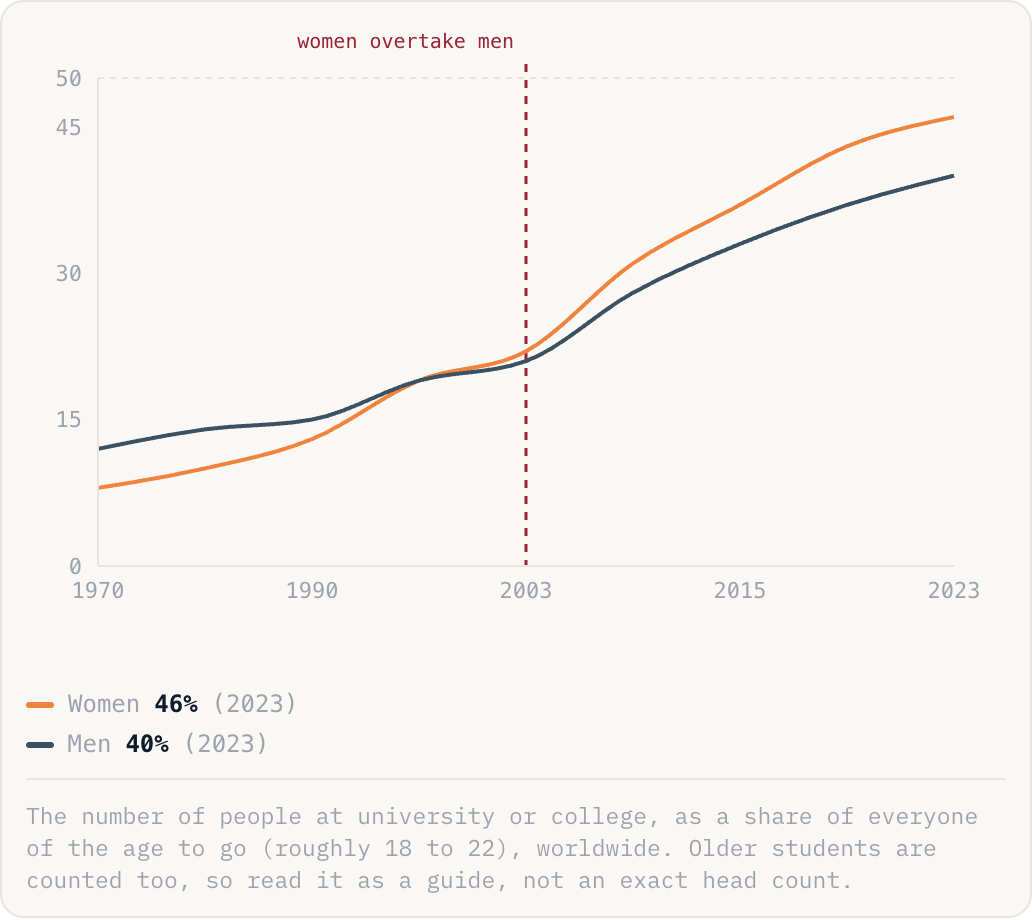
Women46%(2023)Men40%(2023)
The number of people at university or college, as a share of everyone of the age to go (roughly 18 to 22), worldwide. Older students are counted too, so read it as a guide, not an exact head count.
Why this is happening
- Girls do better at school. In almost every rich country girls now get better school results than boys, and university places go to the best results.
- The jobs that grew need degrees. Healthcare, teaching, office work and professional services expanded fastest, and they were more open to women than factory work had been.
- Asia supplied the numbers. China went from about 3 million students in 1998 to more than 40 million today, the biggest expansion of education in history. India is now doing the same.
The take
It changes more than campuses. Women's pay has not caught up: in rich countries, women with degrees earn about three quarters of what male graduates earn, partly because fewer study the best-paid subjects and partly because their pay falls behind after children. People tend to marry someone as educated as themselves, and there are now fewer male graduates to go round, so more women marry men with less education. Politics is splitting too: in many countries young women have moved left while young men have not.