Three in ten of the world's websites now reach you through one company's computers. In 2016 it was one in twenty-five.
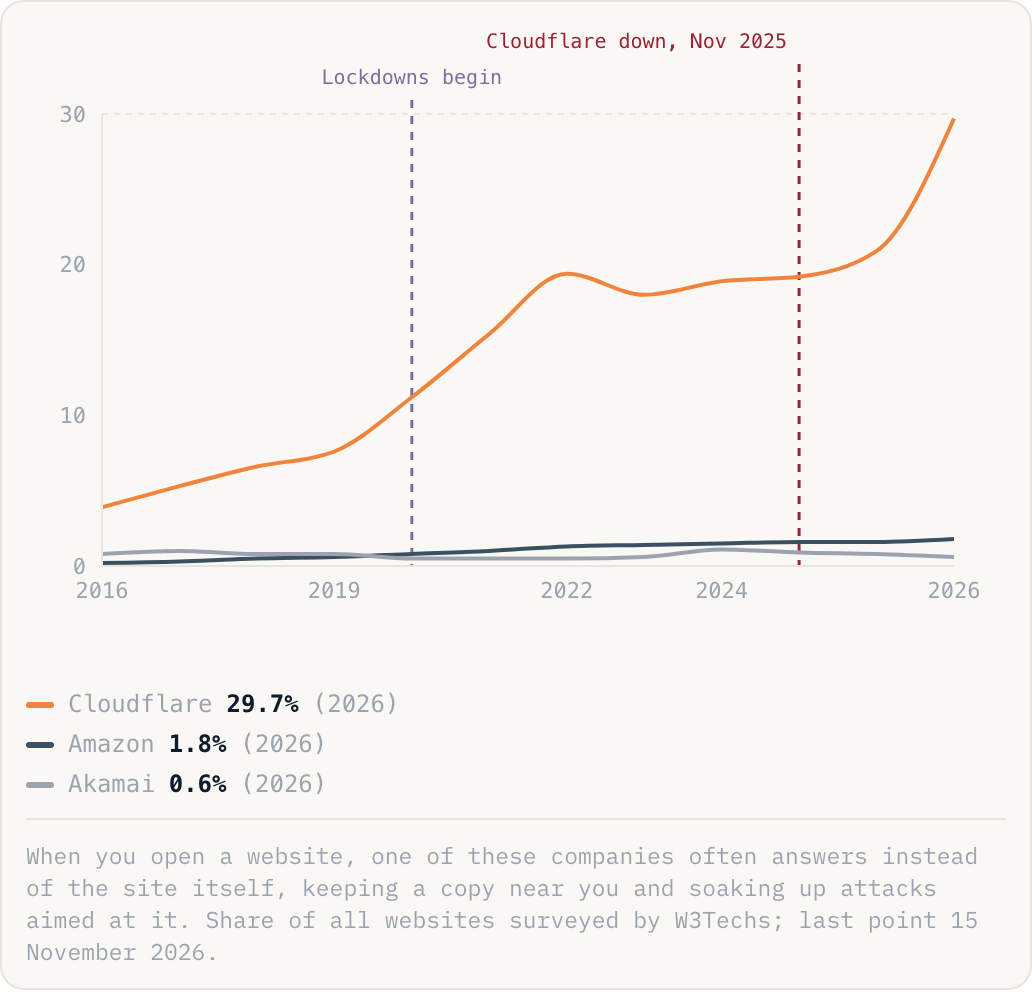
When you open a website, one of these companies often answers instead of the site itself, keeping a copy near you and soaking up attacks aimed at it. Share of all websites surveyed by W3Techs; last point 15 November 2026.
These are the companies that stand in front of other people's websites. Akamai started the business in 1998 and largely invented it, and has 1.8% of it. Cloudflare arrived in 2010, gave the basic service away free, and has 86.6%. The thirty-odd others W3Techs tracks share what is left.
- What they sell is worth having. A copy of the site sits on their computers near you, so pages arrive faster, and when someone floods a site with traffic to knock it over, the flood hits them instead of it.
- Cloudflare gives it away. The basic service costs nothing, so a one-person blog gets much the same protection as a bank. Nothing undercuts free, and the rest of the industry never caught up.
- The big sites are not so different. Among the thousand busiest websites, Cloudflare still answers for six in ten of those that use anyone at all, though Amazon takes a fifth there against a twentieth across the whole web.
The worry is not that Cloudflare is careless. It is that the web now shares one set of mistakes. On 18 November 2025 a routine database change inside the company doubled the size of a single settings file, its own computers started refusing requests, and X, ChatGPT, Spotify and Canva went down with them. Clearing it took nearly six hours. Nobody was attacked.