OPEC once pumped half the world's oil. Today it is barely a third.
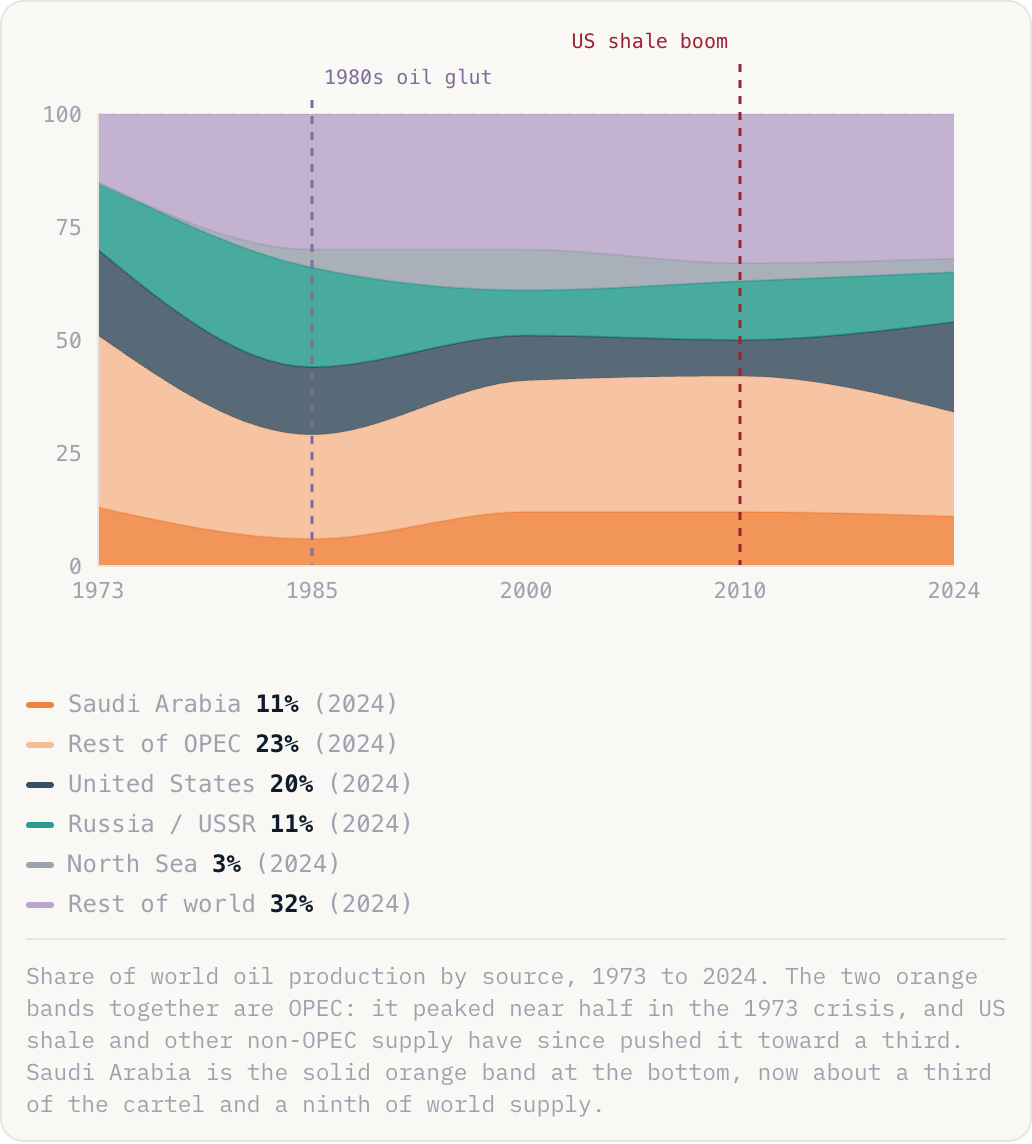
Share of world oil production by source, 1973 to 2024. The two orange bands together are OPEC: it peaked near half in the 1973 crisis, and US shale and other non-OPEC supply have since pushed it toward a third. Saudi Arabia is the solid orange band at the bottom, now about a third of the cartel and a ninth of world supply.
Saudi Arabia, Iraq, the UAE, Iran and Kuwait pump most of it. Angola left in 2024, Qatar and Ecuador earlier. Russia is not a member but coordinates cuts alongside OPEC as the wider group known as OPEC+.
- OPEC is a cartel of oil-exporting states, led by Saudi Arabia, that agree how much to pump so they can steer the price. At its 1970s peak it controlled about half of world supply.
- Every time it cut output to defend the price it handed market share to rivals, and Saudi Arabia absorbed most of those cuts alone. As the cartel's swing producer it went from over 10 million barrels a day in 1981 to under 4 million by 1985, while fellow members kept pumping. In December 1985 it gave up and opened the taps, and the oil price halved.
- The rivals it fed are the other bands: Soviet Siberia, the North Sea, and above all US shale, which added about 9 million barrels a day after 2008. America is now the world's largest producer, roughly a fifth of global supply, so the swing vote on the oil price has moved from Riyadh toward Texas.
OPEC's bind is existential: defend the price and keep losing share to everyone else, or open the taps and crash the price on itself. Shale broke its grip on that choice, and the energy transition threatens the demand underneath both options. Its vast, cheap-to-pump reserves may let it outlast the shale fields, but the age of the cartel setting the world price is over.